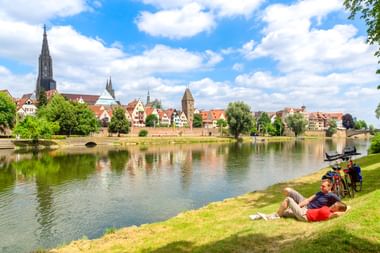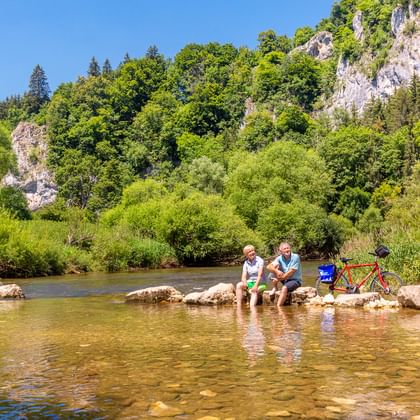
The Danube covers the first 600 kilometers of its long journey in Germany, from Donaueschingen to Passau. And the Danube Cycle Route that follows it has rightly been one of the most popular in Europe for decades! The German section of the Danube Cycle Route is still somewhat inferior to its Austrian brother in terms of popularity and number of cyclists.
But this is precisely the charm of the Danube Cycle Route in Germany: you follow the still-young Danube on its way from a lively bubbling river to a mighty wide stream. On the way, you will not meet the high number of cycling tourists as is the case on the most famous section from Passau to Vienna. Instead, you will get to know southern Germany in a relaxed way from a completely new perspective. You have time for Swabian and Bavarian culture, delicious cuisine, and, last but not least, the opportunity to admire the Danube breakthrough near Kelheim from close up.
On this page, you will find everything you need to know about the Danube Cycle Route in Germany, information on signposting and route quality as well as tips on shortcuts by train. You will also find our bookable cycling holidays on the Danube Cycle Route in Germany on this page because when you're on the road with us, you can concentrate entirely on cycling, we'll take care of the rest: from hotel bookings to route planning, luggage transport and rental bikes.
Let us inspire you!
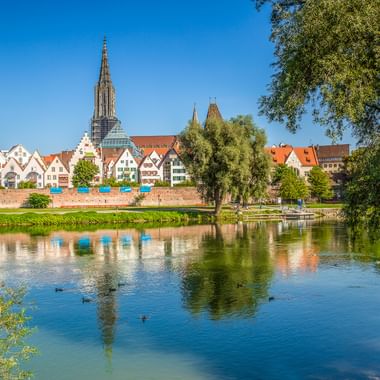
The Danube near Ulm


Our cycling tours along the Danube Cycle Route in Germany
The Danube Cycle Route between Donaueschingen and Passau
Brigach and Breg bring the Danube on its way.
The confluence of the two waters Brigach and Breg gives rise to the Danube at Donaueschingen. However, this did not stop the town's princely family from naming the spring located in their castle garden the source of the Danube. The Danube Cycle Route starts not far from the spring basin set in marble in Donaueschingen. You cycle leisurely on the Danube Cycle Route for the first few kilometers on the Baar plain along the young river. The first natural spectacle awaits you near Immendingen: the Danube Sinkhole. Fortunately, the Danube breakthrough through the Swabian Alb is one of the insider tips on the Danube Cycle Route. Here you cycle idyllically through the impressive landscape. The numerous cycle tourists between Passau and Vienna seem very distant here.
In Sigmaringen, the castle of the Hohenzollern dynasty still gleams in the sun, and the Danube runs right past its walls. The valley now widens. Ulm awaits you with two superlatives as the next highlight: in the border town between Baden-Württemberg and Bavaria stands not only the highest church tower but also the world's most leaning house! Centuries ago, important trade routes crossed in Donauwörth. The past wealth is still visible today in many corners of the town.
In Bavaria, the Danube corresponds to the leisurely folk temperament. The wide, open valley is dominated by historic residences. The Danube Cycle Route takes you via Ingolstadt towards Kelheim. Here, the scenic and culinary highlight of your cycle tour awaits you: the Danube Gorge near Kelheim and the monastery tavern there in Weltenburg Abbey.
The wild and romantic beauty of the Danube Gorge becomes particularly tangible during a boat trip. You can almost hear the legends and tales that once surrounded this impressive landscape. In Weltenburg Abbey, one of the best beers on the Danube Cycle Route awaits you!
In Regensburg, one of the most beautiful old towns in all of Germany awaits you. Via Straubing and Deggendorf, two Bavarian towns straight out of a picture book, you finally reach the three-river city of Passau, at the confluence of the Inn, Ilz, and Danube rivers.
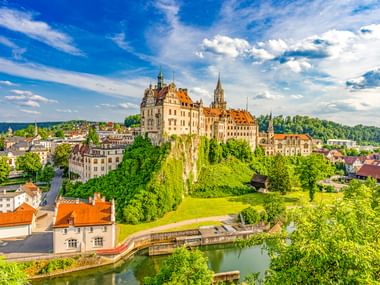
Hohenzollern Castle in Sigmaringen
Short & simple: The Danube Cycle Route in Germany
- Length
Approx. 600 km - Topography
Largely flat trails with occasional climbs as you leave the riverbank. Some of the villages are located on flood-safe hills. Worthwhile detours into the surrounding countryside usually involve a few climbs. - Signposting
The Danube Cycle Route is almost entirely signposted as the German Danube Cycle Route. In addition, you will find the usual cycle route signs, green on white, which indicate the nearest towns and the corresponding distances. - Path quality
The Danube Cycle Route runs largely on dedicated cycle paths and quiet side roads and is well-passable throughout. Some of these are also paved forest and woodland paths.
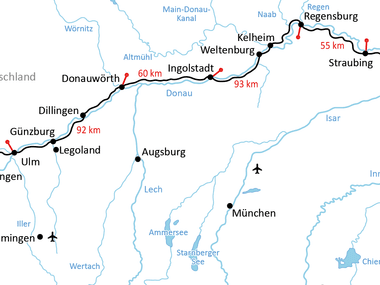
Map - The Danube Cycle Route in Germany
Travel time
Inexperienced cyclists can cover the distance from Donaueschingen to Passau in about two weeks, while more athletic cyclists can cover the 600 kilometers in ten days. As the Danube Cycle Route in Germany is easily navigable throughout and the towns and villages are within easy reach, any combination of stage length and journey duration is conceivable.
However, most cyclists choose either the young Danube from Donaueschingen to Donauwörth or the Bavarian Danube, from Donauwörth to Passau. Both tours promise a leisurely week with enough time to enjoy the cities, towns, and landscape along the Danube in a relaxed way.
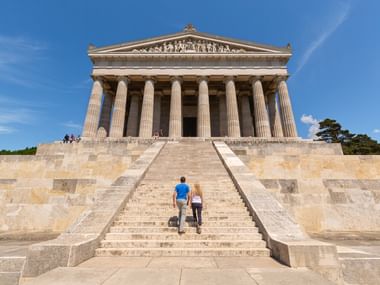
The Walhalla in Donaustauf
Arrival and departure
Donaueschingen and Passau are easily accessible by car. However, due to the 600-kilometre distance between the two towns, it is advisable to travel there and back by train. This way you avoid the time-consuming return journey to your car. Donaueschingen is well connected by regional trains via Ulm and Stuttgart. Passau's main railway station is an ICE stop, so the journey is relaxed.
Other towns on the Danube, such as Ulm, Ingolstadt, and Regensburg, are also important railway junctions. From there, you can also easily reach the smaller towns, for example, Donauwörth. What this means for you is that you can start and finish your tour on the Danube Cycle Route in Germany at almost any location if you are traveling by public transport. Except for Kelheim, Kelheim is one of the few towns on the Danube that does not have its own railway station in town.
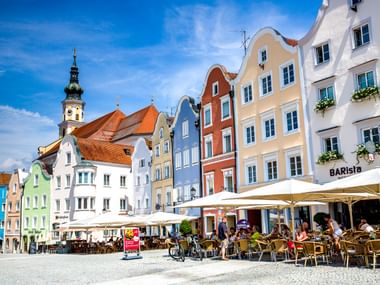
The old town of Schärding on the Danube
Short cuts
The Danube Cycle Route follows a regional railway line over long stretches in Germany. This means that should the weather not suit you or you prefer to spend more time at your next stage destination, you can change to the train and thus cover the next few kilometers. The possible return journey to the end of your trip is also possible without major problems.
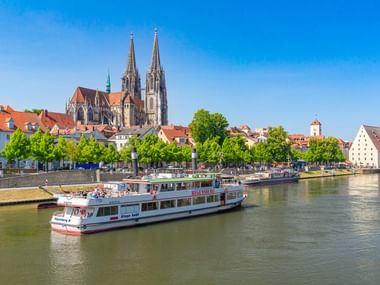
The Danube in Regensburg
Boat trips
The Danube in Germany is only navigable from the tributary of the Main-Danube Canal. Scheduled boats only operate between Deggendorf and Passau. Far more often, however, you have the option of crossing to the other side of the river by ferry or taking a city tour by boat, as in the three-river city of Passau.
Our tip: We would especially like to recommend the boat trip through the Danube Gorge near Kelheim: The steep cliffs through which the Danube has cut its way are particularly impressive from the water!
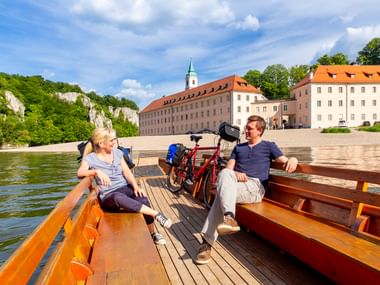
Boat trip to Weltenburg Abbey at the Danube Gorge
Journey back
If you arrive in your own car, you will have to return to your motorised vehicle at the end of your journey: The approximately 600 kilometres from Passau to Donaueschingen can be covered by train in around 8 hours. If you are traveling with your own bicycles, be sure to find out in advance about the current conditions for taking bicycles on the relevant trains!
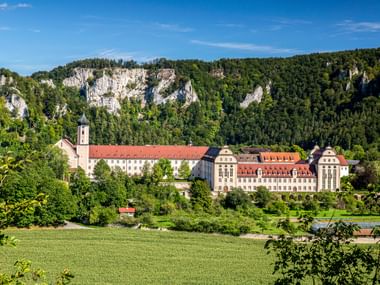
View of Beuron Abbey
Who is the Danube Cycle Route in Germany suitable for?
The German Danube Cycle Route is particularly suitable for leisure cyclists, families and beginners. The predominantly flat route from Donaueschingen to Passau makes for a relaxed cycle, whilst historic towns, monasteries and varied landscapes provide interesting places to stop along the way. Even those who enjoy longer stages will find a suitable challenge on this section, which is around 600 kilometres long.
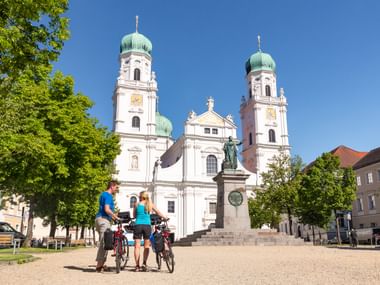
Cyclists in front of Passau Cathedral
Frequently asked questions about the Danube Cycle Route