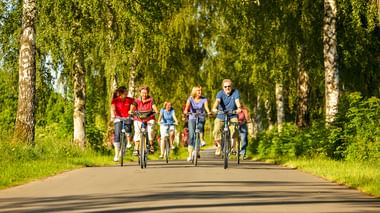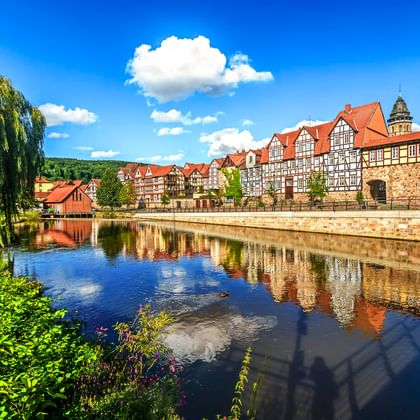
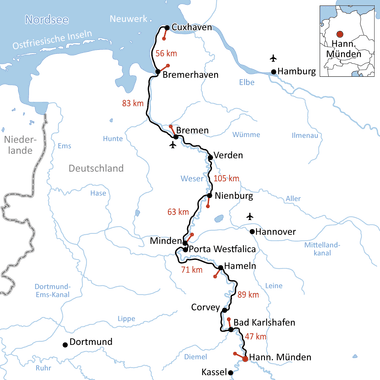
Where the rivers Werra and Fulda meet in Hann. Münden, the Weser is born. This is also where the Weser Cycle Path begins. At around 520 kilometers, the Weser Cycle Path takes you through some of the most diverse regions in northern Germany. Until the Weser flows into the North Sea near Bremerhaven, the cycle path follows it through the hilly Weserbergland, many half-timbered towns worth seeing, and the North German Plain via Bremen to Cuxhaven.
Experience the places associated with numerous legends and fairy tales, the special buildings of the Weser Renaissance, and be enchanted by deep forests and dreamy riverside landscapes.
On this page, we have collected interesting facts about the Weser Cycle Path for you. Information on the topography, signposting and tips on how to get there, ideal travel times, and shortcuts. The cycle path almost always runs parallel to the Weser or within sight of it and many sections can be cycled on both sides of the river, even in the opposite direction. Numerous ferries, spread along the entire length of the river, make it easy to switch to the other side of the Weser cycle path.
And if you prefer to have your cycle tour organized by professionals, then take a look at our bookable cycle tours on the Weser: You cycle, we take care of the rest - from hotel bookings to luggage transport!
Cuxhaven


Our cycling tours along the Weser Cycle Route
On the way from Hann. Münden to the North Sea
The Weser Cycle Path begins at the confluence of the Werra and Fulda rivers in Hann. Münden. You now follow the cycle path past the mountain ranges of the Weserbergland. But don't worry, the cycle path runs almost without gradients along the Weser. You have reached Bad Karlshafen, a pearl of the Weser Baroque. Before you reach the picturesque farming town of Beverungen, it is worth taking a break on the Weser Skywalk near Würgassen. The viewing platform offers you a wonderful view of the river and the surrounding area.
A few kilometers to the north, Fürstenberg Castle and its museum and porcelain factory await you above the Weser. The somewhat arduous climb is worth it! The colorful half-timbered town of Höxter is another highlight along the Weser Cycle Path. Above all, a visit to the Corvey Monastery should be on your must-visit list. The city of scents and aromas Holzminden is best discovered with your nose. A fragrant visitor guidance system leads you through the town. The route continues through Rühler Schweiz, known for its countless cherry trees.
The small town of Bodenwerder is known as the home of the legendary Baron von Münchhausen. Visit the Münchhausen Museum to find out more about the person and the stories of and about the Baron of Lies. Things are also fabulous in Hameln. Explore the historic old town of the Pied Piper town with its many restored half-timbered and Weser Renaissance houses.
After the next bend in the Weser, the town of Porta Westfalica and the Weser breakthrough of the same name await you. The Kaiser Wilhelm monument enthroned above the Weser is a great place to take a break. In Minden, the Weser leaves the Weser Uplands and reaches the North German Plain. As the largest waterway junction in the world, the Mittelland Canal crosses the Weser here. The landscape changes. Flat land, moors, and heaths as well as picturesque villages now accompany you further toward the North Sea. A little away from the Weser, it is worth taking a trip to Steinhuder Meer. Continuing along the Middle Weser, you reach Verden. In this equestrian town, everything revolves around horses.
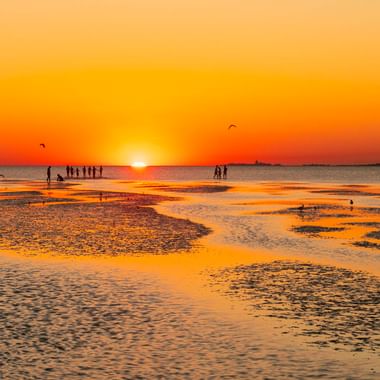
The next highlight on the Weser Cycle Path is the Hanseatic city of Bremen. Stroll through the Schnoor, Bremen's oldest district, try the Bremen specialty of Braunkohl with Pinkel, and treat yourself to a cool beer in one of the numerous beer gardens on the banks of the Weser. Cycle through the Weser marshes to Bremerhaven. Visit the Havenwelten and enjoy the view of the city skyline. From Bremerhaven, you no longer follow the Weser. Now the North Sea is on your left and the moorland on your right as far as Cuxhaven. The Weser Cycle Path ends here. Enjoy the fresh North Sea wind as you watch the Wadden Sea from the Kugelbake, the last corner before America
Route of the Weser Cycle Route
Short & sweet: The Weser Cycle Path
- Length
approx. 520 km - Topography
The Weser Cycle Path runs mostly without gradients. - Signposting
The Weser Cycle Path is signposted throughout with yellow-blue-green signs. Parallel to the main route, there are almost always signposted alternative routes on the other bank. - Quality
Mostly on cycle paths and riverside paths, quiet country roads, and farm tracks. Very rarely on unpaved paths. The quality of the paths could still be improved in a few sections.
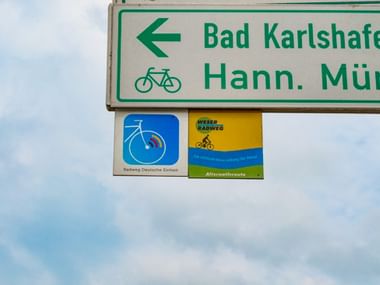
Signposts for the Weser Cycle Route
Travel time
Between April and the end of September is the best time to cycle along the Weser Cycle Path. The cycle path is busy in summer, but don't worry, as it is signposted in both directions and runs along both banks in sections, cyclists are evenly distributed along the route.
Attention: Although there is plenty of accommodation available along the route, it is advisable to book early for the months of July to September.
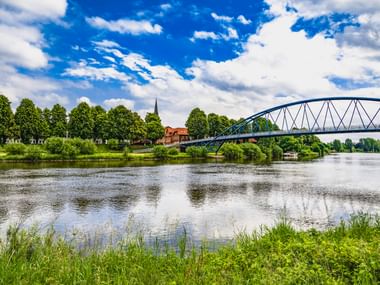
Wesertor Bridge in Nienburg
Arrivals, departures, and return travel
If you want to discover the Weser Cycle Path on your own bike, we recommend traveling by car or train. Thanks to good infrastructure and transport connections, many places along the Weser are suitable as travel destinations. Taking bikes on the train depends on the train. Please enquire in advance whether your chosen connection allows you to take your bike with you.
If you have a further journey to the Weser Cycle Path, the Breme Airport is quite close. The cities of Hameln, Bad Oeynhausen, Bremen, Bremerhaven, and Cuxhaven are connected to long-distance bus routes. Please note that bike transport is limited and must be booked in advance.
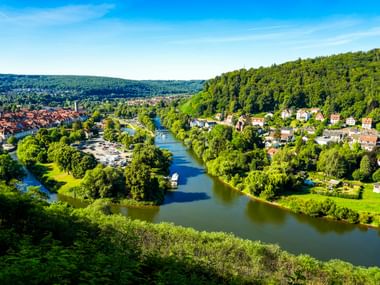
Hann. Münden - Werra, Fulda and Weser
Shortcuts
Unfortunately, the Weser Cycle Path is not accompanied by a continuous railroad line. If you want to shorten your stages due to an unforeseen breakdown or a change in the weather, you may have to take a time-consuming detour by train.
Alternatively, you can use the passenger boats that operate on the Weser. The Flotte Weser, for example, runs between Bad Karlshafen and Bremen. These often take bicycles, but capacity is limited. Please find out in advance about landing stages and travel times. In addition, numerous ferries cross the Weser and allow you to change banks.
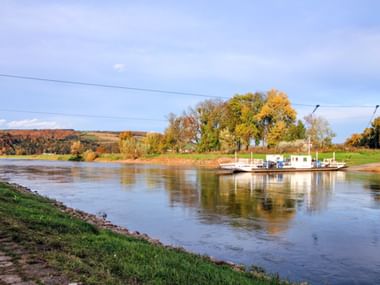
Weser ferry near Polle
Who is out and about on the Weser Cycle Route?
As the Weser Cycle Path has no major inclines, it is particularly suitable for experienced cyclists and families. Also for fairy tale fans, and history and culture enthusiasts. The German Fairytale Route, the Weser Renaissance Route, and the German Half-Timbered Road accompany or cross the Weser Cycle Route. This is the ideal way to combine cycling fun with exploring numerous gems. The nature parks Solling-Vogler (between Bad Karlshafen and Bodenwerder) and Weserbergland Schaumburg-Hameln (between Rinteln and Hameln) are crossed by the Weser Cycle Path - perfect for nature lovers!
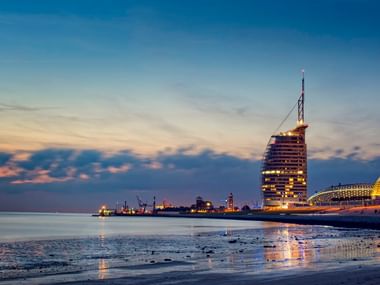
Bremerhaven Harbour with Sail City
Frequently asked questions about the Weser Cycle Route