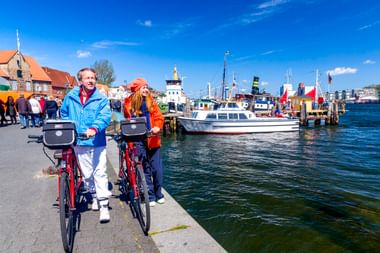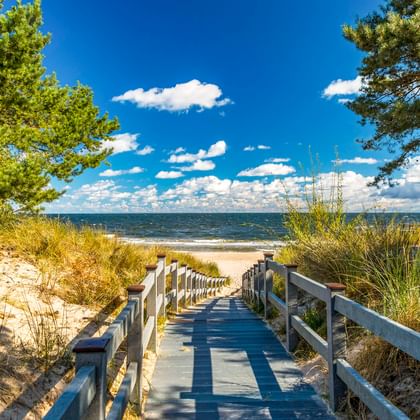
On the Baltic Sea cycle path, there is always a light breeze around your nose and the air is wonderfully clear. Your gaze wanders into the distance, out to the open sea. You are accompanied by the hungry screeching of seagulls. A trip on the Baltic Sea Cycle Route is incredibly diverse:
There are the dreamy fishing villages, the venerable Hanseatic towns with their typical brick culture, the thatched fish huts, the fashionable seaside resorts with impressive piers, and the rugged, meter-high cliffs. You'll want to build one sandcastle after another on the wide beaches. You won't find it difficult to shift down a gear. The clocks just seem to tick a little slower here.
The Baltic Sea Cycle Path does not run continuously along the coast. Again and again, you make detours inland. The surface of the almost 1000 km of the Baltic Sea Cycle Route varies: some parts are very easy to cycle on, and others are more challenging. The route is mostly asphalted, but in places, it runs over slabs, interlocking stones, sand, and gravel or cobblestones.
However, the cycle paths that the Baltic Sea Cycle Route takes you along have one major advantage: they are mostly reserved for cyclists and pedestrians alone or follow country roads with little traffic. You will not have to travel long distances on busy country roads. They only approach main roads to accompany you for a few kilometers on the cycle path. But even these sections are kept to a minimum.
In general, you should therefore travel on a reliable touring bike on your Baltic Sea Cycle Route trip. A longer tour on the Baltic Sea Cycle Path is not recommended for racing bikes.
During our suggested family tours along the Baltic Sea coast, there is a selection of tours that are also great fun with your children in a child trailer. On the other sections of the Baltic Sea Cycle Route, you should find out in advance whether they are comfortable to ride with a child trailer or bike trailer.
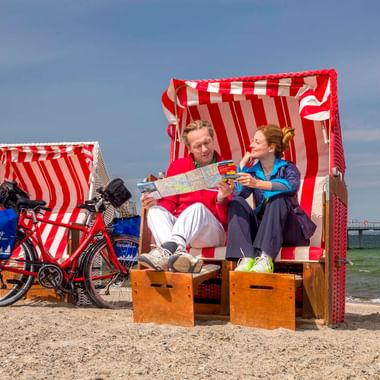
Cyclist in a beach chair near Niendorf
On the Baltic Sea Cycle Route
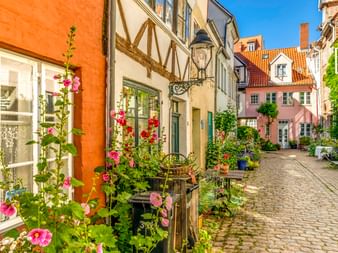
Lübeck’s Old Town
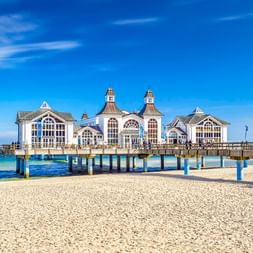
The pier in Sellin
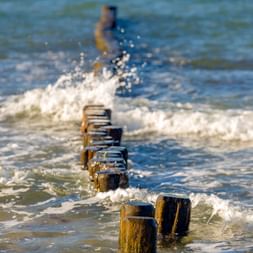
Groynes on Heringsdorf beach
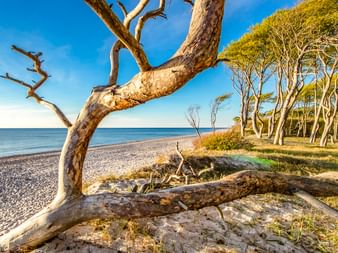
The western beach of the Fischland-Darß-Zingst peninsula
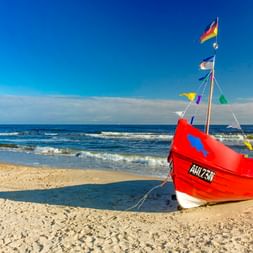
Fishing boat near Ahlbeck
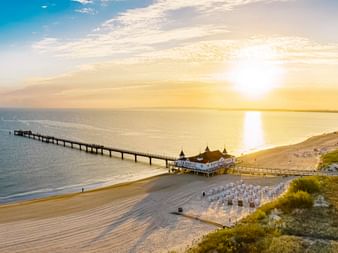
The pier in Ahlbeck
The classics on the Baltic Sea Cycle Route
From Flensburg via Kiel to Stralsund
In Schleswig-Holstein, the coastline and Baltic Sea cycle path from Flensburg to Kiel are much less straight than in the east. Although there are also wide, shallow bays, such as the Bay of Lübeck or Timmendorfer Strand, the coastline is generally more hilly and is interrupted by rivers and fjords or fjords. The Baltic Sea Cycle Route makes frequent detours inland, allowing you to get to know the varied landscape of Schleswig-Holstein.
After a visit to Lübeck, take the Baltic Sea Cycle Route across the state border into Mecklenburg-Western Pomerania. Here, numerous sleepy villages lie behind and between the characteristic buildings of the classicist spa culture. The unique beauty of the coast even attracted emperors and kings, and the Kaiserbäder still tells of this today. Where crowned heads once spent their vacations, today you can enjoy cycling! Numerous breaks on the beach, jumping into the waves to cool off, and then a delicious fish sandwich straight from the fishermen - a cycling vacation on the Baltic Sea cycle path is pure relaxation.
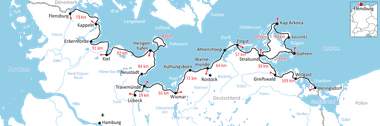
Route of the Baltic Sea Cycle Route
Sweet and short: The Baltic Sea Cycle Route
- Length
approx. 1,000 km - Topography
The Baltic Sea Cycle Route runs largely through flat coastal terrain. Nevertheless, you can expect frequent short, sometimes steep climbs, particularly on sections heading inland. There are also a few metres of elevation to tackle on Rügen – for example, the 161-metre-high Piekberg. The climbs are mostly manageable and are rewarded with lovely descents. - Signposting
The Baltic Sea Cycle Route is signposted with blue, green and yellow signs. However, the quality of the signposting varies: whilst it is very good and clear on some sections, in other places signposts are missing or difficult to spot. A cycle map is therefore recommended as a supplement. - Quality
The quality of the cycle paths along the Baltic Sea coast varies. On well-maintained sections, you’ll make good progress, whilst in other places you should be prepared for less comfortable paths and varying surface conditions.
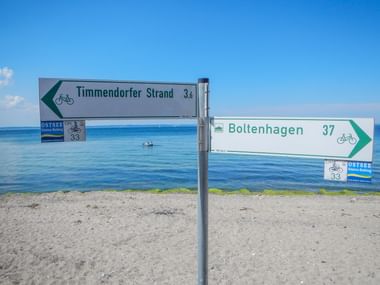
Signposting along the Baltic Sea Cycle Route
Travel time
The seasons are sometimes more pronounced on the Baltic Sea coast than in the rest of Germany. The influence of the sea is always noticeable. Be it with a light breeze and the smell of the sea that accompanies you on your bike tour. Or with a strong wind that, with luck, will blow you in the right direction.
The best time to travel along the Baltic Sea Cycle Route is in the months of June, July, and August. However, this time of year is also very popular with all other tourists, so the Baltic Sea Cycle Route can of course be very busy. Good conditions for a successful cycle tour in terms of the weather can still be found in the wider period between the end of April and the beginning of October.
When planning your trip, you should always take into account the rapidly changing weather and stronger winds and bring the appropriate clothing.
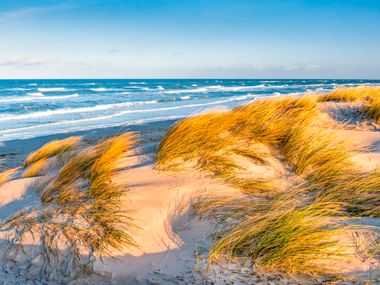
Beach with dunes on the Baltic Sea
Arrivals, departures, and return travel
Flensburg, Lübeck, and Stralsund are the classic starting points for a cycle tour on the Baltic Sea Cycle Route.
From Lübeck and Flensburg, you can explore the western part of the Baltic Sea coast, from Stralsund the eastern part, and the various islands including Rügen. All three cities can be easily reached by public transport as well as via the highway.
The route to Flensburg usually leads via Hamburg, where the nearest international airport is located. IC and regional trains connect the two Hanseatic cities at frequent intervals. Lübeck is also served by ICE trains, so you can easily reach the Baltic Sea Cycle Route from the south and west of Germany.
Stralsund, the hub of the eastern part of the Baltic Sea Cycle Route, is also a stop on various ICE routes. The gateway to Rügen, as Stralsund is often called, can also be easily reached from Berlin with its airports.
The Baltic Sea Cycle Route is also served by various long-distance bus routes. If you are planning to take your own bikes with you, then, as with the train, it is possible to take bikes with you without any major problems.
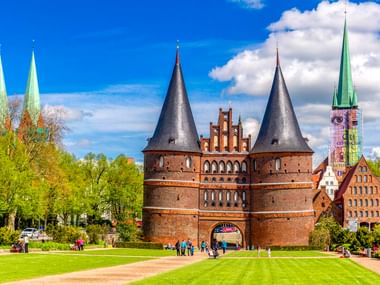
The Holstentor in Lübeck
Shortcuts
Unfortunately, there is no continuous railroad line along the Baltic Sea Cycle Route. Although many places are served by rail, the connection is then only inland. If you want to shorten a stage of your Baltic Sea Cycle Path tour, you may well end up spending a long time on the train.
Various boats, on the other hand, can shorten your stages and be an additional highlight of your cycle tour on the Baltic Sea Cycle Path. The narrow, long bays in particular, at the end of which cities such as Kiel, Lübeck, and Rostock lie, can be wonderfully crossed by boat. The ferries are usually geared towards cyclists, as they have been shortening countless cyclists' stages on the Baltic Sea Cycle Path for years.
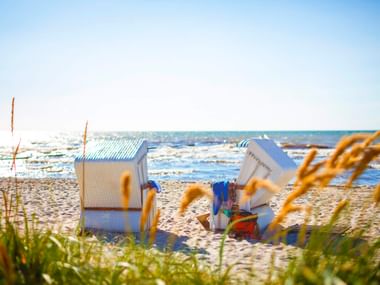
Beach chair in Bansin on Usedom
Who is out and about on the Baltic Sea Cycle Path?
Beaches, lighthouses, steep cliffs, and the waves of the sea - the Baltic Sea Cycle Path is naturally a popular destination for all sea lovers! Nature lovers will get their money's worth here. But culture enthusiasts will also love the Baltic Sea Cycle Route. The former German-German border region has a lot to tell, and not just in terms of recent history. The classicist seaside resorts with their long piers take you back over a hundred years in time.
So if you don't just spend your cycling trip on your bike, but are also interested in what lies along the way, you should definitely not miss a tour on the Baltic Sea Cycle Path. Where else can you spend your breaks taking a refreshing dip in the waves of the Baltic Sea and building a sandcastle before continuing your cycle tour? The many small towns along the way allow for flexible planning. This means that sporty cyclists will also have fun, as the various paths, which are not just flat along the water, are a wonderful way to make kilometers.
Families with children will also have fun on the Baltic Sea cycle path: Sandy beaches that stretch for miles into the horizon, a wildlife that is so foreign and different from the domestic one, make cycling in between almost a minor matter. And who can say after the vacations that they visited a real ghost forest during their vacation?
However, bear in mind that the Baltic Sea cycle path is not suitable for children's trailers everywhere. So if your child is already on a bike themselves, then the Baltic Sea cycle path is only recommended if they can behave safely in traffic and also cycle regularly at home. Otherwise, a relaxing Baltic Sea cycle path vacation will quickly turn into a very stressful time for the whole family.
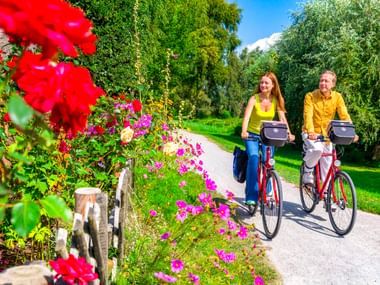
Cyclists on the Baltic Sea Cycle Route near Ahrenshoop
Frequently asked questions about the Baltic Sea Cycle Route