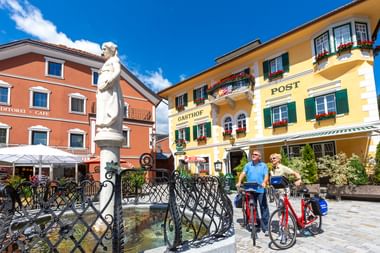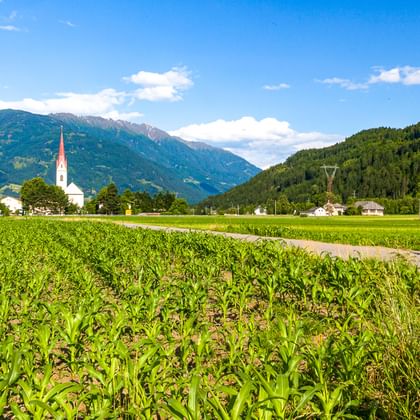
The Drava Cycle Route is without doubt one of the most beautiful cycling routes in Europe! Accompanied by partly rugged, partly gentle mountain ranges and along crystal-clear swimming lakes, the leisurely bike tour on the Drava Cycle Route delights everyone without exception. It runs between the world-famous Three Peaks near Dobbiaco in South Tyrol and the Slovenian university town of Maribor.
The abundance of water, the scenic diversity, the tranquility of a bike trip along the Drava, the culinary delights of the Alpe Adria area and the charming towns and cities: All this makes the charm of the Drava Cycle Route. It enjoys great popularity and convinces its visitors with very well developed infrastructure: The bike route runs mainly on paved roads and is very well signposted. Moreover, about 50 inns cater to hungry and thirsty cyclists along the route. Pack your swimming trunks and experience the coziness and diversity of the Drava.
Learn more about the Drava Cycle Route, its topography and signposting on this page. We also give you tips on how to get there, the ideal season to travel and shortcut options along the Drava Cycle Route.
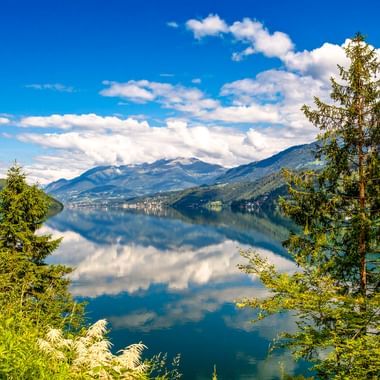
Lake Millstatt, near Spittal an der Drau
On the Drau Cycle Route
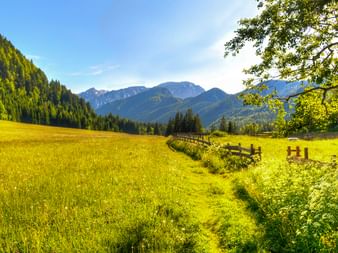
Ferlach on the Drau Cycle Route
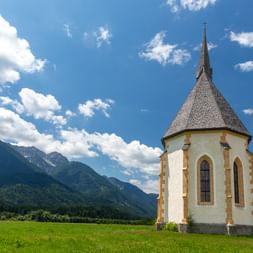
Chapel in Berg im Drautal
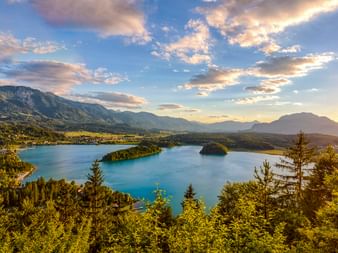
Lake Faaker See
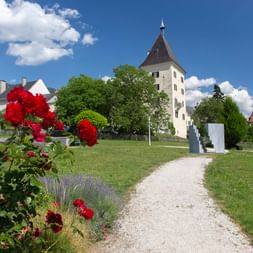
Millstatt Abbey Museum
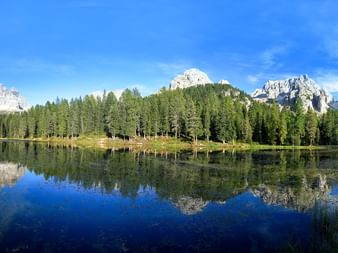
The Three Peaks
The classic tour on the Drava
On the way on the Drava Cycle Route
The Drava Cycle Route starts uniquely and spectacularly in the middle of the Dolomites, the world-famous Three Peaks in sight. On the way to the sunny town of Lienz, the path takes you through the narrow Pustertal valley, lush meadows on the left, rugged mountain flanks of the Dolomites on the right. Villages, castles and Gothic churches lie nestled in the most beautiful nature.
The Drava, fed by numerous torrents, soon becomes a stately river. From Lienz you cycle through a floodplain landscape, where rare animal and plant species have found a home, mountain forests and alpine pastures. You will pass bathing lakes, one more inviting than the other, as well as the Roman archaeological site of Aguntum. From Spittal, famous for its impressive Renaissance castle Porcia, and Lake Millstätter, the route follows the well-maintained Drava Cycle Route, mostly directly on the banks of the river, to Villach. The city enchants with its southern flair. The area around Villach again offers numerous opportunities to take a dip: Faaker See, Wörthersee and Ossiacher See are nearby.
Always leisurely it goes through tranquil villages, past pretty castles such as Wernberg, Ebenau and Rosegg Castle with its zoo. Ferlach, the southernmost town in Austria, situated at the foot of the Karawanken mountain range, looks back on a centuries-old tradition as a gunsmith's town. Ferlach's unique gunsmithing craft was recognized as an intangible cultural heritage by UNESCO in 2010. The last section of the Drava cycle path offers you a lot of variety.
Suddenly the valley widens again and the vibrant university city of Maribor is reached, 2012 European Capital of Culture. Maribor is a gem. Here stands Stara Trta, the oldest vine in the world at 400 years, which still bears grapes. Many beautiful bridges reach across the Drava.
Learn about the classic route along the Drava on our Drava Cycle Path tour. From the sunny town of Lienz, the journey takes you through Carinthia, along the course of the river and the shores of various swimming lakes.
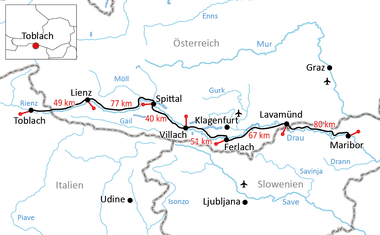
Route of the Drau Cycle Route
Short & Sweet: The Drava Cycle Route
- Length
approx 365 km - Topography
Altitude profile: medium
From Dobbiaco mostly slightly downhill along the shore. Approximately from the Slovenian border, most of the route runs on normal roads. Also sometimes stronger slopes are here to overcome. - Signage
The signage of the Drava Cycle Route is not uniform. In South Tyrol there are isolated light blue signs, signposted as Pustertalweg. In East Tyrol and Carinthia, green signs indicate the way and bear the designation R1. In Slovenia, the Drava Cycle Route is marked with blue rectangular signs and a white cyclist. - Quality
Mostly, the Drava Cycle Route runs along the shore on independent paths, sometimes on side roads with little traffic. The Drava Cycle Route is either asphalted or has a well-passable unpaved surface.
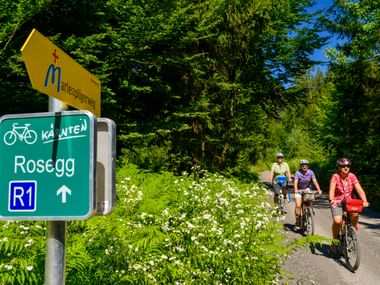
Signpost at Rosegg
Travel season
We recommend that you travel the Drava Cycle Route between May and October. Because then all the inns are open, the last remnants of snow have disappeared and nature is in full bloom. From July to September it is very busy and it can be very crowded on theDrava Cycle Route. But the advantage is that the waters have warmed up to the point where extended swimming breaks are possible.
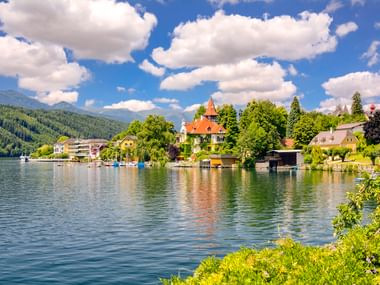
Lake Millstatt
Getting there
Most train connections with IC, EC or regional trains from Germany lead via Salzburg and Innsbruck, regardless of whether you want to start the cycling trip along the Inn Cycle Path from Bressanone, Dobbiaco or San Candido. You must expect multiple changes.
The return journey from Maribor is also somewhat circuitous and not possible without (multiple) changes.
By car, the best way to get to Bressanone is via Munich, Rosenheim and then in the direction of Kufstein and Innsbruck via the Brenner Pass.
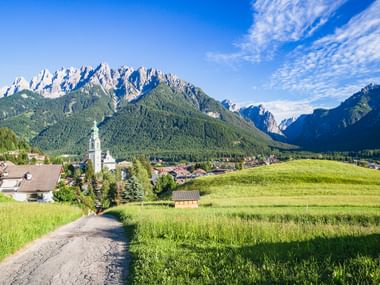
View of Dobbiaco
Shortcut options
The Drava Cycle Route is located on the southern railway line and thus offers optimal flexibility. So you can fall back on public transport in case of bad weather, heavy legs or sudden unwillingness to ride. Please note, however, that the railroad only transports bicycles subject to availability. It's best to check ahead with Austrian Federal Railways, Trenitalia and Slovenian Railways.
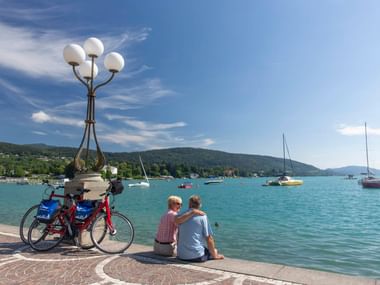
Velden on Lake Wörthersee
For whom is the cycle route suitable?
The Drava Cycle Route is particularly suitable for inexperienced cyclists and families with children on the section from Dobbiaco to just before the Slovenian border. The Slovenian part of the Drava Cycle Route runs in partly steep ups and downs on quiet country roads. This route to Maribor is only recommended for experienced, sporty ambitious riders.
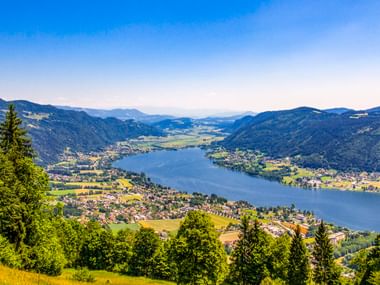
Lake Ossiach near Villach
Frequently asked questions about the Drau Cycle Route